How to Clean a Swimming Pool: Daily, Weekly, and Monthly
How to Clean a Swimming Pool: Daily, Weekly, and Monthly Checklist
How do you clean a swimming pool? Skim the surface daily, brush the walls and vacuum the floor regularly, keep chlorine and pH in the safe range, run your pump every day, and clean the filter when its pressure climbs. A simple routine keeps the water clear, safe, and ready for swimmers.
Below, you'll find a 7-step cleaning guide, daily, weekly, and monthly checklists, and the chemistry numbers that matter most.
How to Clean a Swimming Pool in 7 Steps
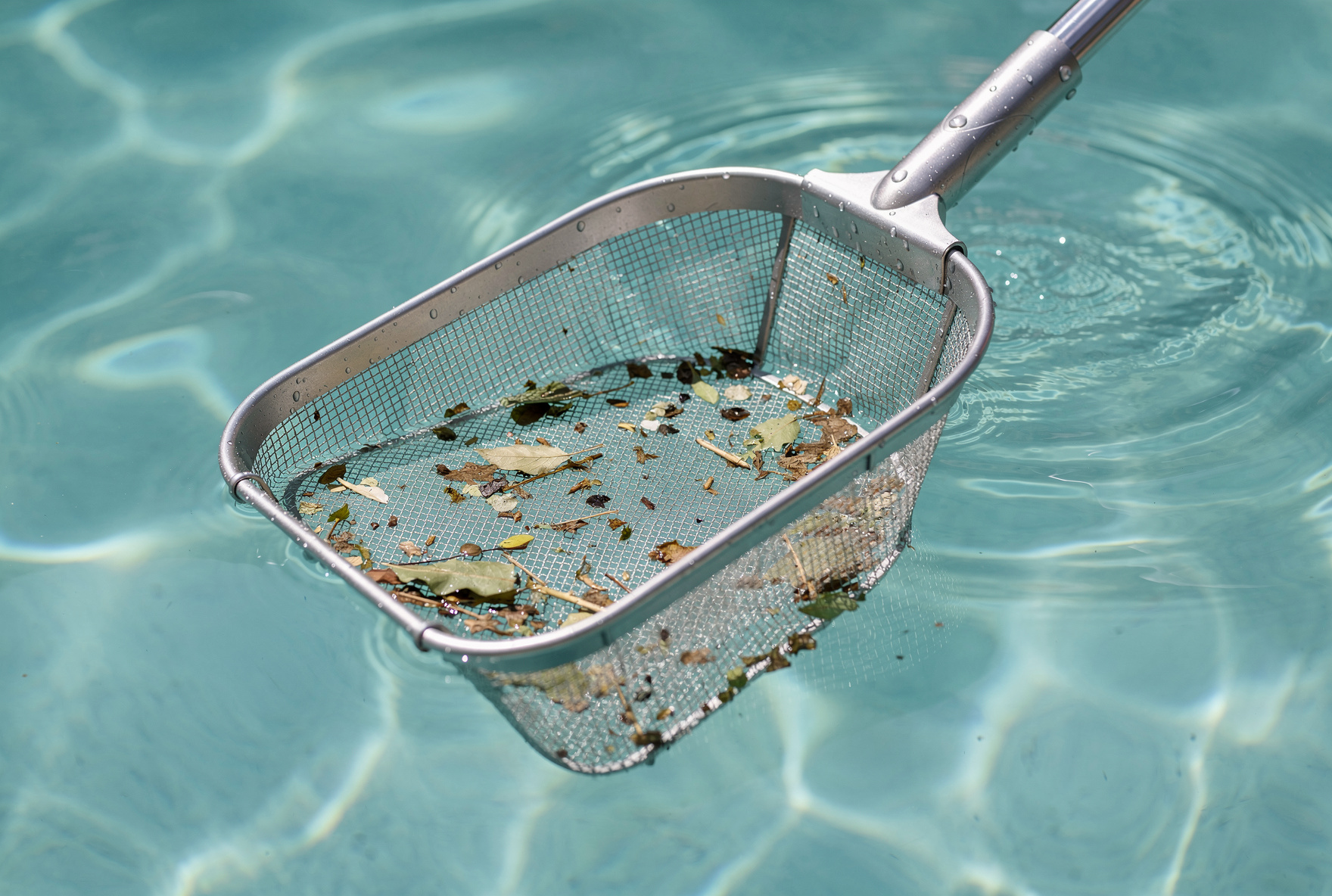
- Skim the surface. Use a leaf skimmer to scoop out leaves, bugs, and debris before they sink. Work the corners and any spots near trees.
- Empty the skimmer and pump baskets. Full baskets make your pump work harder and slow circulation, so empty them at least once a week, and more often if leaves are falling.
- Brush the walls, steps, and ladders. Brushing loosens algae and grime before they take hold. Focus on corners, steps, the spaces behind ladders, and any areas with low water movement.
- Vacuum the floor. Before connecting a manual vacuum, hold the hose underwater until the bubbles stop, so no air gets into the pump. Move the vacuum head slowly in overlapping rows. A robotic or automatic cleaner can save you time.
- Test and balance the water. Check chlorine and pH, and adjust as needed (see the target levels below). Add chemicals slowly, and retest after they've had time to circulate.
- Shock the pool when needed. Shock treatment gives your water an extra dose of sanitizer. Follow the product's directions for how much to use and how long to wait before swimming.
- Check the filter and run the pump. Run your pump and filter at least 8 hours a day. Watch the pressure gauge, and clean or backwash the filter when the pressure rises 8-10 psi above normal.
Your Pool Cleaning Checklist: Daily, Weekly, and Monthly
Daily: Skim the surface, and check that the water level and circulation look right. Test chlorine and pH. The CDC recommends testing at least twice a day, and more often when the pool is busy (CDC). Sweep the pool deck, especially before guests arrive.
Weekly: Empty the skimmer and pump baskets, brush the walls, steps, and ladders, and vacuum the floor. Check your total alkalinity, and top off the water level if it has dropped.
Monthly: Check the filter pressure gauge, and clean or backwash the filter if the pressure is 8-10 psi above normal. Look over the pump, the skimmer lids, and the visible plumbing for leaks or cracks, and wipe down pool furniture, ladders, and handrails.
How Often Should You Clean a Swimming Pool?
Skimming: Every day. Daily skimming keeps debris from sinking and staining the floor (Swim University).
Brushing: At least twice a week, according to Swim University. Algae tends to grow first in corners, on steps, and in other spots with poor circulation.
Vacuuming: About every other day for a busy pool, according to Swim University. At a minimum, vacuum whenever you see debris collecting on the floor.
Chemistry testing: Test chlorine and pH at least twice a day, per the CDC, and more often when lots of people are swimming.
What Chemical Levels Keep a Pool Clean?
Clean-looking water isn't always safe water. Bacteria can grow even when the pool looks clear, which is why balanced chemistry matters as much as scrubbing.
Free chlorine: At least 1 ppm. If you use stabilized chlorine (products with cyanuric acid, like dichlor or trichlor), keep it at 2 ppm or higher (CDC).
pH: 7.0–7.8, according to the CDC.
Total alkalinity: 80–120 ppm (Redfin). Alkalinity helps keep your pH steady, so check it weekly, especially if your pH keeps swinging.
For the most accurate results, the CDC recommends a DPD test kit over test strips. Strips are handy for quick checks, but a liquid kit is better when a result looks off. Whichever you use, follow the manufacturer's directions.
Chemical safety: Store pool chemicals in a cool, dry place, away from the pool and out of reach of kids and pets. Never mix different chemicals together.
How to Keep Your Pool Filter Working
Your filter does the behind-the-scenes cleaning, so it needs regular attention.
Run your pump and filter for at least 8 hours a day (Redfin). If you have a variable-speed pump, longer runs at a lower speed are usually more efficient than short bursts at full power. Not sure how long to run yours? See our guide on how long to run a pool pump.
Keep an eye on the pressure gauge. When it reads 8–10 psi above its normal level, it's time to backwash a sand filter, or to clean a cartridge or DE filter. A sudden drop in pressure can point to a leak or a pump problem instead. If you have a sand filter, see how much sand your pool filter needs when it's time to replace it.
Pick the Right Brush for Your Pool
The wrong brush can scratch your pool's surface. Swim University recommends nylon brushes for fiberglass, vinyl, and painted concrete pools. Stainless steel brushes work for gunite, and a stainless steel and nylon combo works for unpainted concrete.
Keep Your Pool Guest-Ready With Swimply
If you rent out your pool, cleanliness is one of the first things guests notice. Before each booking, give the surface a quick skim, test the water, and check the deck for leaves and bugs.
On Swimply, you can rent your pool to local guests by the hour. You set your own price, hours, and house rules. Most pools list for $25–$100 per hour, and hosts keep 70%–80% of their booking earnings. Learn more about becoming a Swimply host, and see how much it costs to maintain a pool to plan your budget.
How to Clean a Swimming Pool FAQ
How often should I clean my pool?
Skim it every day, brush the walls at least twice a week, and vacuum whenever debris collects on the floor, or about every other day for a busy pool. Test chlorine and pH at least twice a day, as the CDC recommends.
What chlorine and pH levels should a pool have?
The CDC recommends free chlorine of at least 1 ppm, or at least 2 ppm if you use stabilized chlorine with cyanuric acid, and a pH of 7.0–7.8. Keep total alkalinity at 80–120 ppm to help hold your pH steady.
How long should I run my pool pump each day?
Run your pump and filter for at least 8 hours a day. If you have a variable-speed pump, longer runs at a lower speed are usually more efficient.
When should I clean or backwash my pool filter?
Clean or backwash your filter when the pressure gauge reads 8–10 psi above its normal level. Check the gauge regularly so you catch it early.
Can I use test strips to check my pool water?
Yes, for quick checks. For the most accurate results, the CDC recommends a DPD test kit. Use a liquid kit whenever a strip reading looks unusual, and always follow the manufacturer's directions.
Make Your Pool the Place to Be
A clean pool comes down to a few steady habits: skim every day, brush and vacuum regularly, keep your chemistry balanced, and look after your filter. Stick to the routine, and your pool will stay clear, safe, and ready for every swim.